Thursday, May 5, 2016

Preparing for Instruction 3- Intrinsic Motivation

Intrinsic Motivation


I found this really great Info graph (below) explaining the differences between intrinsic and extrinsic motivation and how to encourage intrinsic motivation in your students. Pintrich, Smith, Garcia, & Mckeachie state that "Extrinsic motivation usually...is derived from factors outside the person, such as seeking approval or attaining credentials. Where Intrinsic motivation is usually....internal to the person....and tends to be grounded in challenge, curiosity, and mastery (as cited in Merriam & Bierema, 2014, p.147, Italics added).
Some of these ideas really stood out to me and would be really great to implement into my teaching. I already use some of the ideas listed such as modeling to the students in clinical what I teach them in class, using teams and groups, and creating a trusting atmosphere. One of the ideas listed above that could implement into my teaching is involving my students in community service. There are a lot of seniors in my community who are lonely and could use some company. It would be really neat to implement a community project where students could spend time practicing communication skills while providing the gift of socialization with the at risk seniors.
Another idea that could be implemented is to create a class vision and to collectively set milestones for the class to reach this vision. I think it could be really motivating for the students to set a group goal for the class and to see everyone working hard to reach that goal. We could post the goal on one of the side boards and have different goals set out to reach milestones. An example of a goal could be for the class to go from a group of strangers to a classroom community.  Some of the milestones could be when the language in the classroom shifts from I too we, when tolerance is shown and when showing support for each other’s ideas and feelings becomes a common occurrence.


MacMeekin, M. (2015, May 25). Intrinsic Motivation [Digital image]. Retrieved May 24, 2016, from https://anethicalisland.wordpress.com/2014/05/25/intrinsic-motivation-for-the-classroom/


Reference


MacMeekin, M. (2015, May 25). Intrinsic Motivation for the Classroom. Retrieved May 24, 2016, from https://anethicalisland.files.wordpress.com/2014/05/intrinsic-motivation.jpg?w=800&h=2833
Merriam, S. B. & Bierema, L. L. (2014). Adult learning. San Francisco, CA: John Wiley & Sons.
                                                            

Please note that this blog in its entirety is licensed under creative commons, 

             please see details below:
 

Creative Commons License

Attribution-NonCommercial-ShareAlike
CC BY-NC-SA

This license lets others remix, tweak, and build upon your work non-commercially, as long as they credit you and license their new creations under the identical terms.
View License Deed | View Legal Code

Preparing for Instruction 2- Creating a Positive Learning Environment

Achor, S. (2011). Train your brain [Digital image]. Retrieved May 26, 2016, from http://quote-img.site2quotes.com/quotes/positive-quotes-shawn-achor-494.png


I choice a fast passed and funny TED talk by Shawn Achor to share on the topic of positivity. I felt really inspired by many points he made in this talk but one idea, in particular, stood out to me:


 "What I found is that most companies and schools follow a formula for success, which is this: If I work    harder, I’ll be more successful. And if I’m more successful, then I’ll be happier. That undergirds most of our parenting styles, our managing styles, the way that we motivate our behavior.
And the problem is it’s scientifically broken and backwards for two reasons. First, every time your brain has a success, you just changed the goalpost of what success looked like. You got good grades, now you have to get better grades, you got into a good school and after you get into a better school, you got a good job, now you have to get a better job, you hit your sales target, we’re going to change your sales target. And if happiness is on the opposite side of success, your brain never gets there. What we’ve done is we’ve pushed happiness over the cognitive horizon as a society. And that’s because we think we have to be successful, then we’ll be happier.
But the real problem is our brains work in the opposite order. If you can raise somebody’s level of positivity in the present, then their brain experiences what we now call a happiness advantage, which is your brain at positive performs significantly better than it does at negative, neutral or stressed. Your intelligence rises, your creativity rises, your energy levels rise. In fact, what we’ve found is that every single business outcome improves. Your brain at positive is 31 percent more productive than your brain at negative, neutral or stressed" (Achor.S, 2011).


Achor recommends using a few different methods daily for 21 days to help increase positivity in your life. The recommendations include listing 3 daily gratitudes, journaling about one positive thing that happened in your day, exercise, meditation, and a daily random act of kindness.

I feel that these 5 steps could easily be implemented into the classroom, especially in a particular course we teach the Health Care Aides called Lifestyles and choices. It could be a 21-day challenge project to help students become more positive and some of the steps such as journaling or meditiation could even be implimented into class time. See TED talk below.


                                                                     References

Achor, S. (Writer). (2011). The Happy Secret to better work [Motion picture on Ted Talk]. USA: TEDxBloomington.


Please note that this blog in its entirety is licensed under creative commons,
 please see details below:


Creative Commons License


Attribution-NonCommercial-ShareAlike
CC BY-NC-SA

This license lets others remix, tweak, and build upon your work non-commercially, as long as they credit you and license their new creations under the identical terms.
View License Deed | View Legal Code


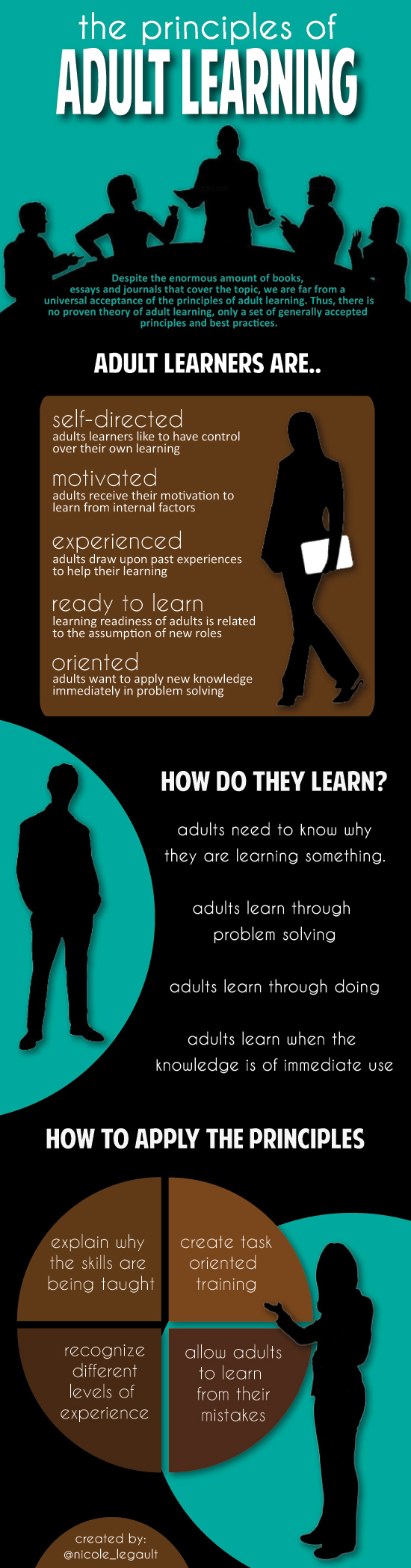

Preparing for Instruction 1- Characteristics of Adult Learners


 Legault, N. (2011, September 25). An Overview of the Principles of Adult Learning. [Digital image]. Retrieved May 24, 2016, from https://nlegault.ca/2011/09/25/infographic-an-overview-of-the-principles-of-adult-learning/

       According to Merriam and Bierema (2014), adult learners differ from children in a few ways; "an adult is in a different position in the life span than a child,...going to school is a child's full-time job! Adults, in contrast, have many other roles and responsibilities" (p.11). "Another dimension that differentiates adult learners from children is an adult's life experiences and that.... adults are developmentally at different stages in the life cycle (p.12, italics added). I found this really great infographic that visually puts together Merriam and Bieremas characteristics of adult learners.

        I find this info graph appealing because it includes four points as to how the principles of adult learners can be applied. One way I can implement these principles in the classroom is making sure I have a clear rationale for each topic or skill that is discussed in the skills lab. Adult learners like to know why and one way I can prepare for this is to have rationale available. For example, if I was teaching the skill of bed making, when I explain the importance of making sure the flat sheet is smooth, I can add in that creases in the sheets can cause breakdown and pressure sores to the skin of  an immobile patient.

       Another way i can use these principles in my teaching is to allow the adult learners to learn from their mistakes, in the lab environment. Instead of having them demonstrate a skill step by step as the instructions are read, I could have them show the skill as they think it is supposed to be done and then give them feedback as to where they could do better at the end. This would allow them to make the mistakes and learn how to correct those mistakes.

        This info graph was an easy way to understand the characteristics of an adult learner and i hope you find it as useful as i did.

                                                                  Article 

 https://nlegault.ca/2011/09/25/infographic-an-overview-of-the-principles-of-adult-learning/


                                                            References      
Legault,N(2011,September 25).[INFOGRAPHIC] An Overview of the Principles of Adult Learning. Retrieved May 24, 2016, from https://nlegault.ca/2011/09/25/infographic-an-overview-of-the-principles-of-adult-learning/

Merriam, S. B. & Bierema, L. L. (2014). Adult learning. San Francisco, CA: John Wiley & Sons.


          Please note that this blog in its entirety is licensed under creative commons,
                                                         please see details below:


Creative Commons License

Attribution-NonCommercial-ShareAlike
CC BY-NC-SA

This license lets others remix, tweak, and build upon your work non-commercially, as long as they credit you and license their new creations under the identical terms.
View License Deed | View Legal Code

Trends in Adult Education-Focusing Activites


 focusing activities
 [Photograph of Adult Learners]. Retrieved May 13, 2016

                I didn’t realize when I started researching for this blog, how many articles there would be on trends in adult education. I found it very interesting to see many of these trends focused around using more technology in the classroom. One article, in particular, Three Focusing Activities to Engage Students in the First Five Minutes of Class, provides insightful advice on ways to use focusing activities to “ … immediately focus students’ attention as soon as they walk in (or log in) to the classroom” (Honeycutt, 2016). I found myself inspired by two of the focusing activities presented in the article, looping slide deck and ordering exercise. The looping slide deck can be made of PowerPoint slides that continually loop like the ones played on the screen at the movie theater before the movie starts. The slides, according to Honeycutt, could contain “interesting facts about the university, popular trivia questions, answers to students’ most frequently asked questions, announcements about upcoming events in the nearby community, …pictures of campus landmarks,… multiple-choice questions, quotes from the reading, fill-in-the-blank sentences….important announcements for upcoming deadlines etc.” (2016). I could really see this idea working to help focus the Health Care Aide students that I teach. This would be a great method to present review questions and hints for upcoming exams and to present the motivation for students to arrive on time.
                Another idea Honeycutt presented in the article was making up ordering exercises. Honeycutt describes how this focusing activity can be used, “If you have a list of processes or procedures that must be completed in a certain order, you might want to try this focusing activity. Post the list of steps or procedures on the screen and make sure the list is out of order. As students come in, ask them to start putting the list in the correct sequence based on established criteria” (2016). This idea could be used in the Health Care Aides skills lab. The students have a list of checklists that they must memorize and demonstrate competency in.  This would be a good activity to help them study the correct order of steps.  I really enjoyed this article by Dr. Barbi Honeycutt, check it out for yourself in the link below:

                                                           Article

http://www.facultyfocus.com/articles/blended-flipped-learning/three-focusing-activities-engage-students-first-five-minutes-class/

                                           
                                                        Reference

Honeycutt, B. (2016, May 02). Three Focusing Activities to Engage Students in the First Five Minutes of Class. Retrieved May 15, 2016, from http://www.facultyfocus.com/articles/blended-flipped-learning/three-focusing-activities-engage-students-first-five-minutes-class/

Please note that this blog in its entirety is licensed under creative commons,
 please see details below:

Creative Commons License

Attribution-NonCommercial-ShareAlike
CC BY-NC-SA

This license lets others remix, tweak, and build upon your work non-commercially, as long as they credit you and license their new creations under the identical terms.
View License Deed | View Legal Code

Trends In the Canadian Health Care System


[Photograph of young and aged hands]. Retrieved May 13, 2016, from:http://hosted-p0.vresp.com/840495/5ebfe591c1/ARCHIVE

One trend that is dominating the Canadian health care system is the rise in elderly patients. According to the Canadian Medical Association, it is estimated that by 2036, seniors will account for 62 percent of Canada’s Health Care costs (Ostroff, 2015). Growing up as a millennial, I heard many theories about what the retirement of the Canadian Baby Boomer Generation could look like.  Some said there would be no money left in the Canadian Pension Plan for the future generations. Others said that the inability to fill all the vacant jobs positions would be a problem, so we would need to increase immigration. Something I didn’t hear however was how an aging population would overwhelm the Canadian health care system.  Working in the Health Care system as a nurse, I can see daily how overwhelmed our system has become with an influx of seniors awaiting placement for assisted living, long-term care and palliative beds.
In the article (see link below), I have chosen to reflect this trend, there are some incredible statistics. I really appreciate Dr. Chris Simpson’s honesty throughout the article and acknowledgment that this has become a Health Care crisis. Having had an opportunity to work as a community nurse the past 3 years, I agree with Dr. Simpson’s thoughts to “de-hospitalize the health-care system and invest more into home care solutions” (Ostroff, 2015). If you were to ask any Baby Boomer where they see themselves in 10 years, the majority would say still at home. Currently seniors can access home care for support with activities of daily living (ADLs) such as medication reminders, bathing, and assistance with dressing. However, there is no current federal or provincial funding in place for seniors to be assisted with housework or to do house modifications, which would allow them to stay in their home longer. When our hospital’s become overcrowded with seniors awaiting placement it affects the entire Canadian Population. It means fewer hospital beds available for all age groups and unfair treatment to a generation who helped build Canada into the thriving country it is today. 

Article

 Reference
Ostroff, J. (2013, October 13). How To Defuse The Baby Boomer 'Demographic Bomb' And Save Health Care. Retrieved May 05, 2016, from http://www.huffingtonpost.ca/2015/10/13/national-seniors-strategy-canada-election-eldercare_n_8260078.html


Please note that this blog in its entirety is licensed under creative commons,
 please see details below:

Creative Commons License

Attribution-NonCommercial-ShareAlike
CC BY-NC-SA

This license lets others remix, tweak, and build upon your work non-commercially, as long as they credit you and license their new creations under the identical terms.
View License Deed | View Legal Code

A Brief Autobiography

Hello!

Thank you for taking the time to check out my Blog. This Blog is a place for me to document my thoughts on topics and text of the Provincial Instructor Diploma Program, through Vancouver Community College. I currently live and work in a small rural community in Trail, BC, Canada. I am a Licensed Practical Nurse and College Instructor for the Health Care Aide program, Selkirk College. I have a passion for teaching and look forward to expanding my knowledge in Adult Education, as I work towards completing my diploma through VCC- School of Instructor Education. I also co-own a small Jewelry business with my sister, Dual Hearts Designs. We encase Butterfly wings into necklaces, rings, earrings and other items. In my free time (between my 5 jobs... I have so much of that haha), I love to be outdoors with my dogs, Lexi, and Buster, as well as with my partner, Andrew. I have a deep love for podcasts, some of my favorites include: Serial, TED Radio Hour, This American Life, Saw Bones and Stuff You Should Know. I also enjoy watching Movies and TV shows on Netflix, have you seen Stranger Things? I look forward to reading any comments and am open to any feedback anyone may have.


Enjoy,

Chantal

 Please note that this blog in its entirety is licensed under creative commons, please see details below:


Creative Commons License

Attribution-NonCommercial-ShareAlike
CC BY-NC-SA

This license lets others remix, tweak, and build upon your work non-commercially, as long as they credit you and license their new creations under the identical terms.
View License Deed | View Legal Code